
From ad hoc notes to structured workflows: How Bergen Hospital Trust digitised cannulation support requests
For many years, cannulation support at Bergen Hospital Trust relied on informal routines, verbal agreements and personal judgement. Requests were often made in passing with a simple question: “Can someone help with a cannulation?”

Digitised cannulation support requests have simplified the process.
To keep track, some staff even wrote tasks on a piece of tape attached to the back of a pager. While pragmatic, the approach made information difficult to share, highly person-dependent, and easy to lose sight of in a busy clinical environment.
The initiative came from the anaesthesia nurses at the Surgical Service Clinic, who wanted a more structured and robust workflow for ordering and following up requests for assistance with blood sampling and cannulation. The eHealth and Western Norway Regional Health Authority ICT department helped translate this need into a digital task workflow.
A workflow dependent on individuals
When the need for cannulation support arose, staff often had to search for whoever might be available. Tasks were not collected in a single place, and anaesthetic nurses lacked a shared overview of pending requests.
This created an unpredictable working day for both those requesting support and those carrying out the work, with no consistent way of distributing or following up on tasks.
Digitising a critical clinical process
Bergen Hospital Trust’s ambition was not simply to introduce a new tool, but to improve the underlying workflow.
By introducing a digital task management approach, requests for cannulation support could be submitted digitally, tasks were clearly allocated, and both requesters and clinicians could follow progress in real time. At the same time, it became much easier to ensure that tasks were actually followed up and completed.
What was previously an informal and fragile process was replaced by a structured workflow where tasks are visible and responsibilities clearly defined.
What changed in practice?
The changes were quickly noticeable in daily operations.
For clinicians requesting support, it became easier to submit requests and track status without having to search for available staff.
For anaesthetic nurses, the solution provided a shared overview of all incoming tasks, making it easier to prioritise and distribute work more evenly.
The result was a more predictable and manageable working day on both sides of the process.
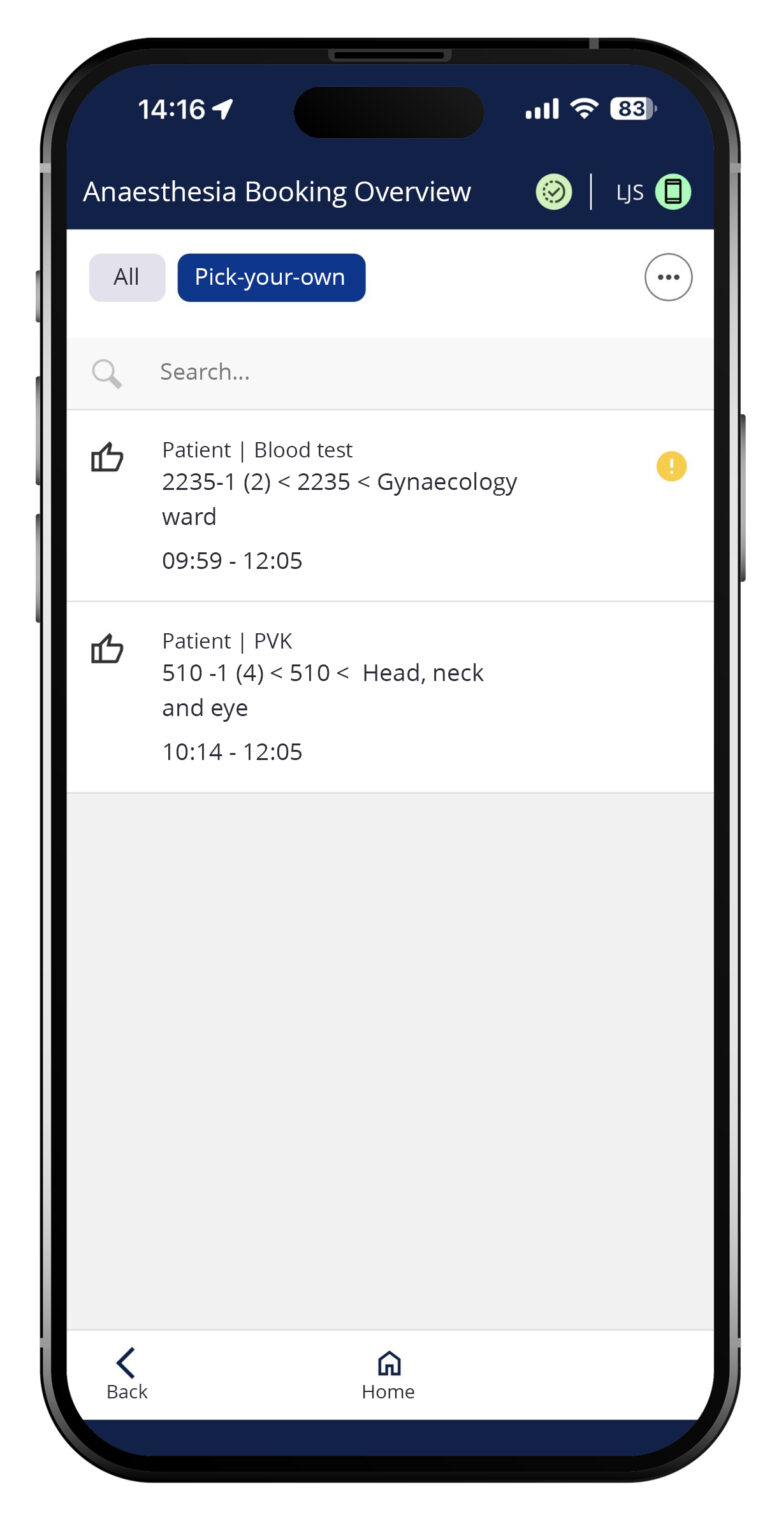
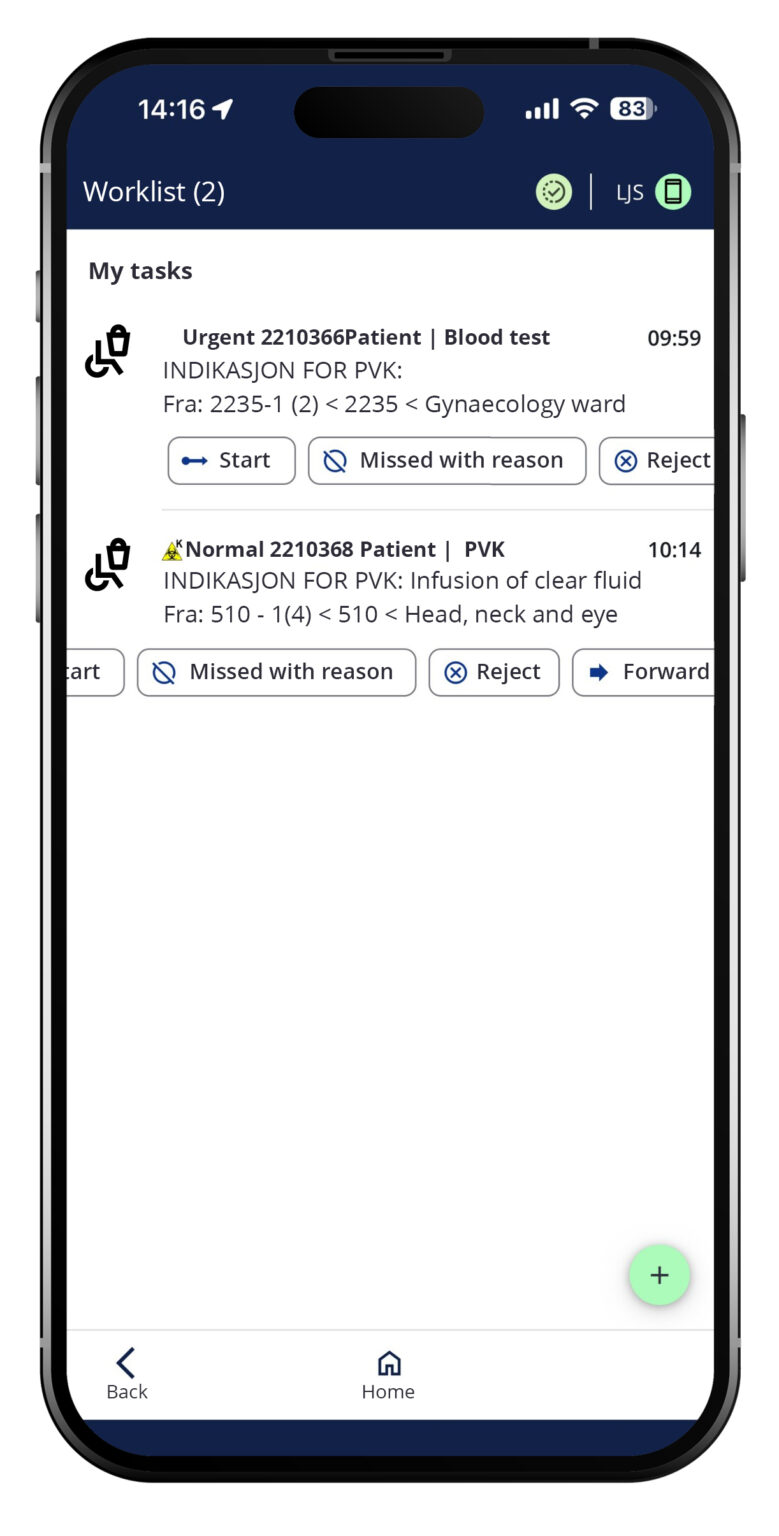
Anaesthetic nurses have a shared overview of all incoming tasks.
Lessons from implementation
As with any organisational change, the rollout required adaptation and learning along the way. Expectations had to be aligned, training needed to fit clinical operations, and consistency across departments was important.
Bergen Hospital Trust highlights four key lessons from the implementation:
- Tailor training to actual clinical workflows
- Clear needs drive meaningful change
- Benefits must be felt in everyday work
- Keep it simple
Start with the workflow, not the tool
The experience from cannulation support has relevance beyond this single process. The same principles can be applied to many other clinical workflows: start by understanding the process, make tasks and responsibilities visible, and ensure solutions are simple to adopt.
By focusing on workflow first rather than technology, healthcare organisations can often gain more value from existing systems such as DNV Imatis.
From fragile process to predictable operations
The outcome is a more transparent, efficient and predictable workflow. By making tasks visible, clarifying responsibilities and establishing a simple and consistent way of working, Bergen Hospital Trust has improved oversight and made better use of available resources.
The case illustrates how targeted digitalisation of specific clinical processes can deliver meaningful improvements in day-to-day operations, without requiring large organisational changes.